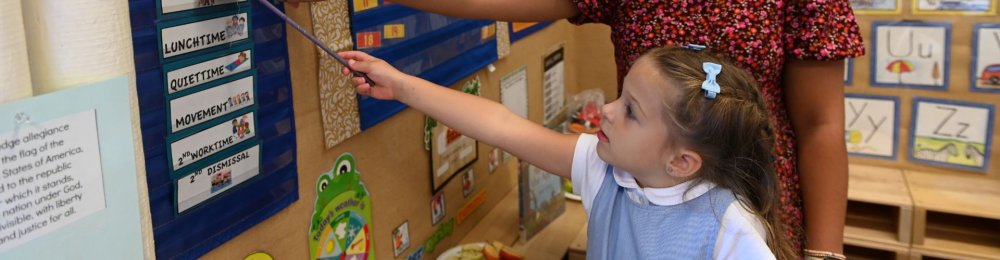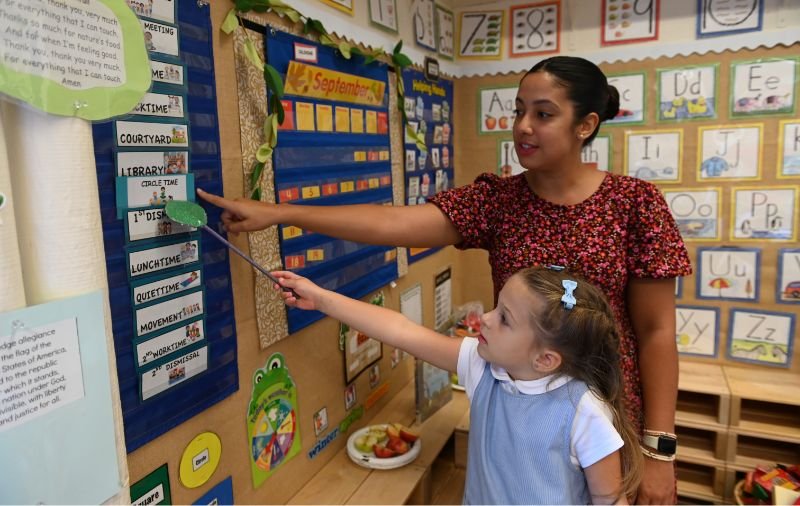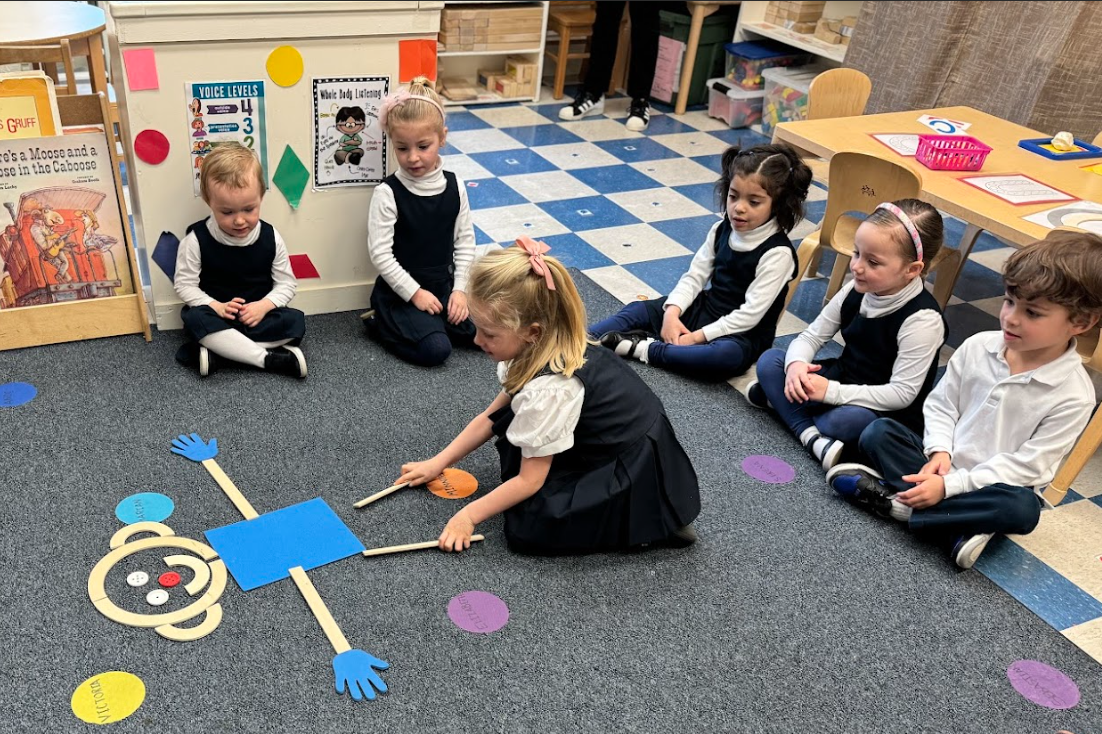
The Early Childhood Program (Nursery & Pre-Kindergarten) focuses on the development of the whole child: intellectual, social, emotional, spiritual, and physical. Within a structured yet creative environment, the children learn to explore their world, communicate, make choices, and develop independence. As they grow in awareness of their own abilities and needs, they learn about the needs and abilities of others. The students begin to understand their role as members of a community based on mutual respect, sharing, and love.
NURSERY
Through varied activities, the students make the important discovery that learning is exciting and enjoyable. Whether building in the block corner, pouring at the water table, or dressing for dramatic play, the Nursery children develop a clear sense of self.
LANGUAGE ARTS
The language arts program encourages children to develop both receptive and expressive forms of language. By enriching and expanding vocabulary, the children develop the ability to communicate knowledge and to listen with understanding. The curriculum is designed to promote reading readiness. Along with strengthening appropriate listening and verbal skills, the children refine their visual and auditory discrimination. Classification, memory, and sequential activities further enhance their skills. As they become ready, children begin to recognize letters and develop an awareness of letter-sound relationships. The experience of hearing stories read and told helps to develop the children’s imaginations and nurtures enthusiasm for books. In addition to using the classroom reading corner, the Nursery class also visits the school library and learns to appreciate books as a source of pleasure and information.
MATHEMATICS
The program for the Nursery class focuses on the development of a basic understanding of mathematical concepts and relationships. Instruction is approached through the use of games, observations, discussions, and discoveries made while using concrete objects and materials. Children are given numerous opportunities to count, compare, sort, and organize materials as a basis for the development of symbolic and ultimately abstract thought.
SOCIAL STUDIES
The program strives to develop the children’s understanding of themselves as unique and capable individuals within a social context. It fosters the children’s awareness of and responsibility for their own behavior and its effect on the people and things in their environment. The children are helped to develop skills which enable them to maintain good interpersonal relationships within the classroom, home, and community. Age-appropriate field trips are scheduled to local points of interest such as the Metropolitan Museum of Art and the Greenburgh Nature Center.
SCIENCE
The science curriculum is geared toward helping children develop the skills of inquiry, exploration, and discovery as they relate to their environment. Activities are designed to develop a natural curiosity in everyday experiences and to enable children to investigate, manipulate materials, observe events, discuss observations, and classify objects.
RELIGIOUS STUDIES
The religious studies program in the Nursery focuses on the individuality of each child and the need to be kind and compassionate. The Nursery children learn about themselves and their families, what makes each of them special, and how they are each God’s unique creation. With their first introduction to Bible stories and participation in Early Childhood chapels, the children begin to appreciate God’s love and the many gifts God gives them.
ART
Art is an integral part of the Nursery program, designed to offer children experiences that promote creativity, expression, and experimentation. Through a wide variety of experiences, the children develop increased fine motor skills, spatial perception, and the ability to use their language skills to describe their artwork. The year culminates with an interdisciplinary theme unit, “I Am Special,” that includes the creation of self-portraits.
MUSIC
The Nursery music program provides varied opportunities to experience and explore music. Folk music, rhymes, dance, creative movement, and instrumental play form the basis of a multi-sensory approach to music. Students regularly share their music at assemblies and special programs.
PHYSICAL EDUCATION AND MOVEMENT
Students engage in activities that encourage exploration through movement. Play involves fine and gross motor skills and eye-hand coordination. The ability to participate in structured games is developed during the second semester.
INFORMATION AND COMMUNICATION TECHNOLOGIES
Nursery students are introduced to interactive software on laptop computers and iPads. These applications enhance the students’ discovery in many subject areas, encourage cooperative learning, and develop the students’ fine motor skills.
PRE-KINDERGARTEN
In the Pre-K classroom, the children are encouraged to become more independent learners, capable of making reasoned choices. The activities in the program reinforce the importance of becoming a social member of the group. Increased focus on letters and numbers helps foster strong pre-reading and pre-math skills.
LANGUAGE ARTS
The language arts program focuses on the refinement of receptive and expressive forms of language. The program is designed to enrich and expand vocabulary, to increase comprehension of spoken language, and to enhance the child’s ability to articulate in a meaningful way. The Pre-K program consists of an individual approach to help children further develop reading readiness skills. Age-appropriate listening and verbal skills are practiced in order to develop auditory discrimination. Additional activities promote classification, memory, sequencing, and visual discrimination skills. Poems, stories, songs, and dramatic play are all an integral part of the program. The Pre-K class participates in regularly scheduled trips to the library, where the librarian reads stories to them. Children learn how to care for books and how to appreciate books independently.
MATHEMATICS
Mathematics focuses on extending the children’s basic understanding of mathematical concepts and relationships through the use of games, observations, discussions, and discoveries. While using concrete objects and materials, children have numerous opportunities to count, pattern, sort, and organize materials. As they are ready, children are introduced to concepts and materials of increasing complexity.
SOCIAL STUDIES
The social studies program continues to foster the child’s understanding of her or himself as a unique and capable individual. The children learn about roles within a community and the meaning and celebration of holidays around the world. Age-appropriate field trips are scheduled to points of interest such as the Metropolitan Museum of Art and the local firehouse. In addition to content material, children are helped to further develop social skills that enable them to enjoy good interpersonal relationships with their peers.
SCIENCE
The focus of the Pre-K science program is to help the children further develop the natural skills of inquiry, exploration, and discovery as they relate to their environment. Activities are based on everyday experiences designed to encourage questioning, investigation, manipulation, comparison, testing, measuring, observation, classification, and communication. Students also develop computer-related skills through the exploration of science-related software. Instruction is enhanced by visits to Central Park and a variety of field trips.
RELIGIOUS STUDIES
The religious studies program in Pre-K continues the focus on each child as a unique creation loved by God. Bible stories and children’s literature teach lessons about our world and our abilities. Stories of saints provide models for living God’s way. The study of holidays highlights significant Judeo-Christian events and develops an appreciation of different religious beliefs. Students participate in chapel services and begin to learn Catholic rituals.
ART
Art is an integral part of the Pre-K program. Through a wide variety of art experiences, the children express their ideas while manipulating color, space, line, and form. They experience the rewards of artistic accomplishment. Famous artists are explored through class discussion. Visits to the Metropolitan Museum of Art enhance the program and stimulate creativity and art appreciation.
MUSIC
The Pre-K music program further fosters an exploration of music. Students sing, dance and play instruments. In addition, they begin early rhythm reading and note recognition. They regularly share their music by participating in assemblies, chapel services and other special programs.
PHYSICAL EDUCATION AND MOVEMENT
Students engage in activities that encourage exploration through movement. Play involves both fine and gross motor skills. The ability to participate in structured games is developed through involvement in various physical activities.
INFORMATION AND COMMUNICATION TECHNOLOGIES
Pre-K students explore interactive software on laptop computers and iPads. These applications enhance the students’ discovery in many subject areas, encourage cooperative learning, and develop the students’ fine motor skills.